The Bread of Life
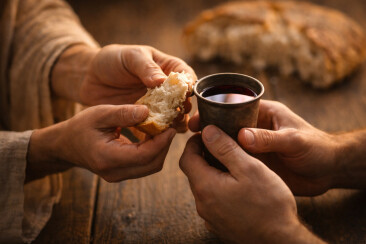
Throughout the New Testament, Jesus made many bold claims about Himself. He said He was the door, the vine, the shepherd, the way, the truth, and the life. One of the most difficult claims for His followers to accept was when Jesus said He was the bread of life(John 6:32–71).
As we read the Bible, we inevitably encounter passages that are hard to understand. Often, understanding the cultural and historical context helps clarify what initially seems confusing.
The idea of the bread of life goes back to Moses and the Israelites in the wilderness. While they traveled through the desert, God provided them with manna from heaven for each day. From it, they made bread and survived for forty years. Bread quite literally meant life to them.
Because of this, bread was deeply revered. Hands were washed before handling it. It was broken by hand, never cut with a knife. When bread was passed, it was handled with both hands as a sign of respect. People often broke bread together when making a covenant because both parties would consume the same bread, uniting them together.
Can you start to see how Jesus might correlate with the bread of life?
Hand feeding someone bread was a sign of love. If bread was dipped and then fed to someone, as Jesus did to Judas at the Last Supper, it was like saying, “I love you so much I would die for you.” What’s remarkable is that Jesus did this for Judas even though he knew Judas would betray him that night.
In John 6:35, Jesus says that whoever comes to him will never hunger and whoever believes in him will never thirst.
Once, I fasted for the healing of a friend. I chose to fast like Esther—without food or water for three days—though I knew going without water was potentially dangerous. (I figured that if I needed to, I could drink water.) Every time I got hungry or thirsty I would either read some Scripture or chat with God in prayer. Each time, the hunger and thirst faded as I did that. I got to experience Jesus’ words in Matthew 4:4: “Man shall not live by bread alone, but by every word that proceeds from the mouth of God.” Jesus is the Word, and he is the bread of life, which gives new depth to that statement.
Jesus went even further, saying he was the living bread from heaven and that the bread he gives is his flesh. He said:
Unless you eat the flesh of the Son of Man and drink His blood, you have no life in you. Whoever eats My flesh and drinks My blood has eternal life, and I will raise him up at the last day. (John 6:53-54 NKJV)
This shocked his listeners. Jewish law strictly forbade consuming blood or human flesh, making this teaching extremely difficult to accept. Many followers left him, saying, “This is a hard saying; who can understand it?” When Jesus asked the Twelve if they wanted to leave too, Peter replied, “Lord, to whom shall we go? You have the words of eternal life.”
The disciples chose to trust Jesus even when they didn’t understand. They didn’t yet know how this promise of life would be fulfilled.
Jesus later explained it at the Last Supper, a Passover meal. He took actual bread and said it was his body, and wine and said it was his blood and passed them around to his disciples to consume. (This is the foundation for the “communion” that we take periodically.) During Passover, four cups of wine are traditionally shared, each with specific meaning. The cup Jesus identified as his blood was the cup of redemption—powerfully symbolizing that through his blood, we can be redeemed to God.
How about you? Are you willing to give God the benefit of the doubt when you come across a difficult passage? Are you willing to trust God rather than your own understanding? I would challenge you to lean into a hard saying of Jesus rather than ignoring or rejecting it. Usually there is something amazing to be found if you look deep enough; sometimes it just takes patience for God to reveal it to you—like it did for the disciples. But even if you don’t see it, just trust that His ways are higher than our ways, and His thoughts, than our thoughts (Isaiah 55:8).
If this encouraged you, check out more articles from our Flatirons Spiritual Formation Team for practical tools, encouragement, and ways to grow in your faith and leadership. Click here.